


Inclusion and SEND
At Palm Bay Primary School we strive to create an inclusive teaching environment that offers all pupils, no matter their needs and abilities, a broad, balanced and challenging curriculum. We are committed to offering all pupils the chance to thrive, fulfil their aspirations and to prepare them for the next stage in their education. Our aim is to give pupils support to be successful learners, but also to promote greater independence. We will achieve this by making reasonable adjustments to teaching, the curriculum, as well as the school environment to make sure that pupils with Special Educational Needs & Disabilities (SEND) are included in all aspects of school life.
To learn more about SEND please watch the video below:
Definition of Special educational needs:
A pupil has SEND if they have a learning difficulty or disability that requires special educational provision to be made for them.
They have a learning difficulty or disability if they have:
- A significantly greater difficulty in learning than most others of the same age, or
- A disability which prevents or hinders them from making use of facilities of a kind generally provided for others of the same age in mainstream schools
Disability
Pupils are considered to have a disability if they have a physical or mental impairment that has a substantial and long-term adverse effect on their ability to do normal daily activities.
The school will make reasonable adjustments for pupils with disabilities, so that they are not at a substantial disadvantage compared with their peers.
The 4 areas of need
The needs of pupils with SEND are grouped into 4 broad areas. Pupils can have needs that cut across more than 1 area, and their needs may change over time.
Interventions will be selected that are appropriate for the pupil’s particular area(s) of need, at the relevant time.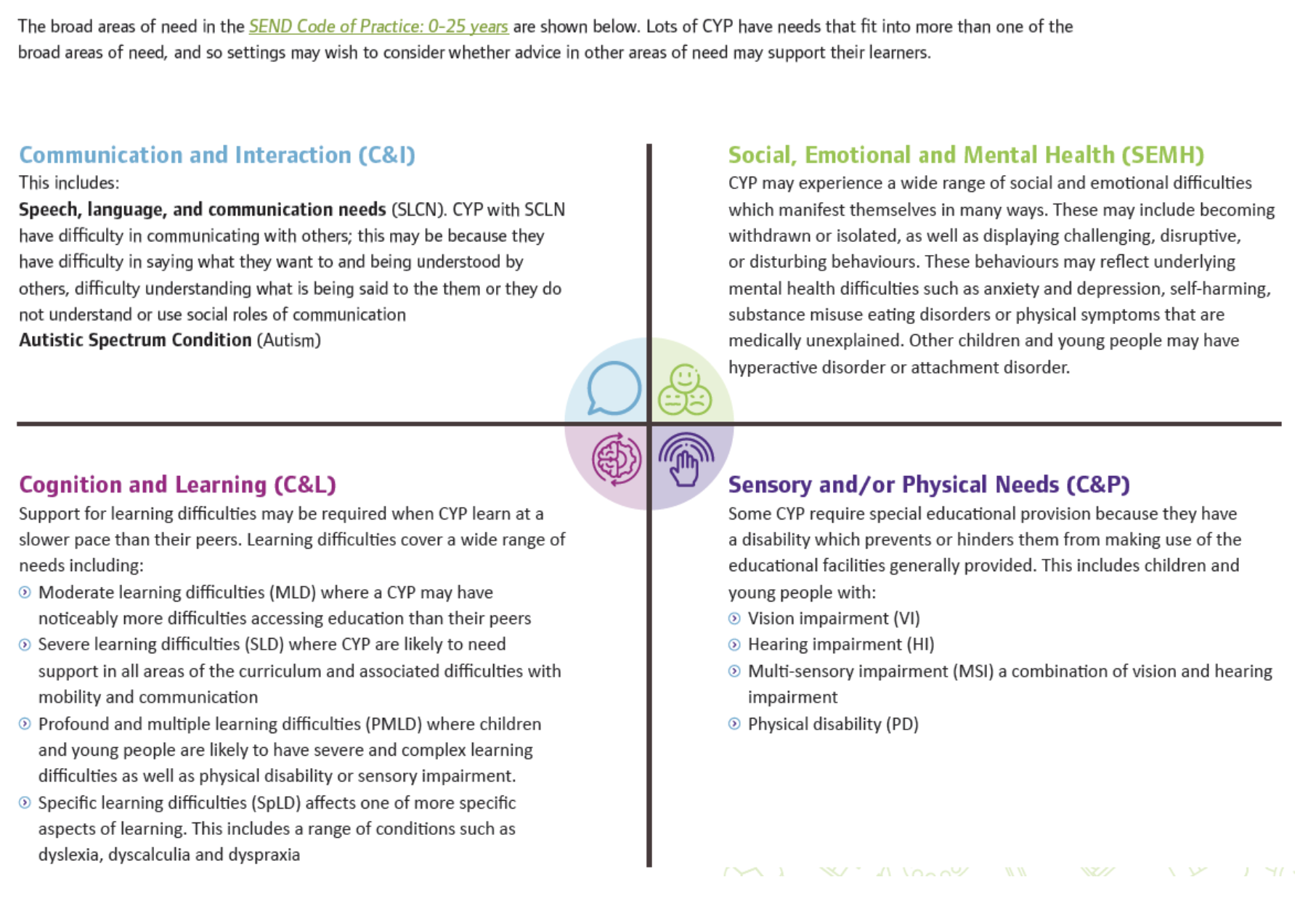
Palm Bay’s approach to SEND Support
At Palm Bay all teachers are responsible and accountable for the progress and development of all pupils in their class, including pupils who access support from specialist staff. High quality teaching, adapted, for individual pupils, is the first step in responding to pupils who have SEND. ‘Quality First’ teaching is a priority of the school. Teaching is regularly monitored and there is a focus on continual improvement of the teaching of all pupils, including Continuing Professional Development (CPD) and the understanding of strategies to identify and support vulnerable pupils.
Palm Bay regularly and carefully reviews the quality of teaching for all pupils, including those at risk of underachievement. This includes reviewing and, where necessary, improving, teachers understanding of strategies to identify and support vulnerable pupils and their knowledge of the SEND most frequently encountered.
SEN Code of Practice (2014, 6.37)
Palm Bay follows the Mainstream Core Standards developed by Kent County Council to ensure that our teaching conforms to best practice.
Identifying and Supporting pupils with SEND
Every pupil has their progress closely monitored through termly pupil progress meetings and assessments. Pupils who are not making expected progress are highlighted and interventions or additional support are put in place. The school may also seek support from Send Inclusion advisor, Link Professionals or Community of Schools.
We also assess each pupil’s current skills and levels of attainment when they start at the school. This builds on information from previous settings and Key Stages, where appropriate. We will also consider any evidence that the pupil may have a disability and if so, what reasonable adjustments the school may need to make.
Class teachers will regularly assess the progress of all pupils and identify any whose progress:
- Is significantly slower than that of their peers starting from the same baseline
- Fails to match or better their previous rate of progress
- Fails to close the attainment gap between them and their peers
- Widens the attainment gap
This may include progress in areas other than attainment, for example, wider development or social needs.
When teachers identify an area where a pupil is making slow progress, they will target the pupil’s area of weakness with adapted, high-quality teaching. If progress does not improve, the teacher will raise the issue with the SENDCo/Assistant SENDCo to have an initial discussion about whether this lack of progress may be due to a special educational need. Where necessary they will, in consultation with the pupil’s parents or carers, consider consulting an external specialist. At Palm Bay Primary School we monitor the progress of all pupils three times a year to review their academic progress. We also use a range of assessments with all the pupils at various age related stages. These may include, YR screening, Y1 phonics screening, speech link, language link, spelling age, reading age, reading and maths standardised assessments, such as NTS and end-of key stage SATs.
Slow progress and low attainment will not automatically mean a pupil is recorded as having SEND. Staff will also take particular care in identifying and assessing SEND for pupils whose first language is not English.
When deciding whether a pupil needs special educational provision, we will start with the desired outcomes, including the expected progress and attainment, as well as the views and the wishes of the pupil and their parents/carers. We will use this to determine the support that is needed and whether we can provide it by adapting our core offer, or whether something different or additional is needed.
If a pupil is joining the school, and:
- Their previous setting has already identified that they have SEND
- They are known to external agencies
- They have an education, health and care plan (EHCP)
The school will then work in a multi-agency way to make sure it receives all the relevant information before the pupil starts at school, so support can be put in place as early as possible.
The graduated approach to supporting SEND
At Palm Bay Primary School we use the Assess, Plan, Do, Review approach to supporting children with SEND.
Once a pupil has been identified as having SEND, we will take action to remove any barriers to learning, and put effective special educational provision in place. This support will be delivered through successive rounds of a 4-part cycle known as the graduated approach.
|
Assess |
The class teacher and the SENDCo/Assistant SENDCo will carry out a clear analysis of the pupil’s needs. The views of the pupil and their parents/carers will be taken into account. The school may also seek advice from external support services. The assessment will be reviewed regularly to help make sure that the support in place is matched to the pupil’s need. For many pupils, the most reliable way to identify needs is to observe the way they respond to an intervention. |
|
Plan |
The teacher and the SENDCo/Assistant SENDCo will decide which adjustments, interventions and support will be put into place, the expected outcomes, and a clear date for review. All staff who work with the pupil will be made aware of the pupil’s needs, the outcomes sought, the support provided and any teaching strategies or approaches that are needed. This information will be recorded on our management information system, Arbor, and will be made accessible to staff in a Personalised Provision plan. Parents will be fully aware of the planned support and interventions, and may be asked to reinforce or contribute to progress at home. |
|
Do |
The pupil’s class or subject teacher retains overall responsibility for their progress. Where the plan involves group or 1-to-1 teaching away from the main class or subject teacher, they still retain responsibility for the pupil. They will work closely with any Inclusion Practitioners or specialist staff involved, to plan and assess the impact of support and interventions and how they can be linked to classroom teaching. All information regarding interventions will be recorded on the class intervention tracker. The SENDCo/Assistant SENDCo will support the teacher in further assessing the pupil’s particular strengths and weaknesses, in problem solving and advising on how to implement support effectively. |
|
Review |
The effectiveness of the support and interventions and their impact on the pupil’s progress will be reviewed in line with the agreed date. We will evaluate the impact and quality of the support and interventions. This evaluation will be based on:
The teacher and the SENDCo/Assistant SENDCo will revise the outcomes and support in light of the pupil’s progress and development, and in consultation with the pupil and their parents. |
Level of support at Palm Bay
|
Stage |
Description |
What it looks like in practice |
|
1. In Class |
Quality First Teaching (Universal Offer) |
• Inclusive classroom practice for all pupils. • Adapted tasks and scaffolding. • Visuals, prompts, flexible grouping, and sensory breaks • Teacher monitors progress closely and adapts teaching. • Focus on removing barriers through classroom adjustments. |
|
2. Small Support in Class (Resources) |
Early Targeted Support (Low-Level Additional Help) |
• Additional adult support for short periods. • Targeted resources (word mats, writing frames, overlays, fiddle toys). • Use of intervention trackers and provision maps. • Focused feedback and short, structured catch-up tasks. • Teacher consults with SENDCO for advice. |
|
3. Specific Input |
SEN Support – Targeted Interventions |
• Pupil placed on SEND Register. • Personalised Provision Plan (PPP) created. • Targeted 1:1 or small-group sessions for specific needs (e.g. Speech Link, Language Link, phonics, Thrive). • Regular reviews with parents and pupil voice. • May involve external agency advice (e.g. SALT, STLS). |
|
4. Intensive Groups |
Higher-Level Support (Specialist & Sustained) |
• Frequent, longer interventions or alternative timetabling. • Access to nurture or communication group • Multi-agency input – CAMHS, OT, EP. • Personalised curriculum elements. • High adult-to-child ratio and close progress tracking. |
|
5. EHCP |
Education, Health and Care Plan (Statutory Support) |
Formal multi-agency plan outlining provision, outcomes, and funding. • Support above and beyond school resources. • May include 1:1 provision, bespoke timetables, specialist equipment. • Annual Review process and ongoing multi-agency input. • Inclusion in mainstream where appropriate. |
Where can I find more information?
The Government guide to SEND for Parents:
Link to Services:
special education needs and inclusion/ SEN directory & important links
EKC- https://ekcschoolstrust.org/information-for-families/
School Contacts
Mrs Tracy Cripps is the SENDCo at Palm Bay Primary school: TracyCripps@palmbay.uk
Mrs Jane Campbell is the Assistant SENDCo: janecampbell@palmbay.uk
PALM BAY SEND PROVISION AND POLICIES
WHAT IS THE SEND LOCAL OFFER?
Every local authority must publish a Local Offer. The SEND Local Offer tells you what support is available for children and young people with special educational needs (SEN) and/or disabilities, and their families. It should include information about education, health and care provision. It should also tell you about training, employment and independent living for young people with special educational needs and/or disabilities.
You can find the SEND Local Offer for Kent County Council (KCC) at www.kent.gov.uk/education-and-children/special-educational-needs
Mainstream core standards for parents
SEND home school agreement